Showing posts with label Isfahan. Show all posts

Monday, 22 October 2007

Safavid Period Architecture


Safavid art refers to art in Persia (Iran) during the dynasty of the same name (1501-1722), a high point for the art of the book and architecture; other art at the time included ceramics, metal and glass.


Esfahan(Isfahan)

For the third time in the history of the Safavids, the capital of the empire changed under Shah Abbas: to Isfahan, a city in a more centralized location than Tabriz or Qazvin (which is between Tehran and Tabriz). A new capital was thus set up beside the ancient city, organized around a meydan, a large place 512 metres long by 159 wide. On one side stands the Shah's mosque, on the other the Shah's oratory, called the mosque of Sheikh Lutfallah, while the pavilion Ali Qapu opens onto a large pleasure walkway (Chahar Bagh) and the grand bazaar led to the old mosque on Fridays. Two bridges cross the Zayandeh River, leading to an Armenian section taking the name of Nea Julfa.


Chaharbagh school

 
A tiling collection, The Madresse chaharbagh, or royal school, also named after the king's mother; is one of the last, but otherwise most beautiful works of Safavid period architecture. It was built at the time of Shah Sultan Hussain, the last of the safavid kings. The building also displays the art of tile work at its best. It is an example of late Safavid period tile work. On the eastern wing of the school was the king's mother caravansary, a place for travellers to rest. Today it has been turned into the magnificent Abbasi Hotel, itself a museum of post-Safavid works of art. (17th century after Christ).


Photos by Mehrdad Tadjdini

Tuesday, 2 October 2007

Iran, Esfahan, Chadegan


Chādegān (also

Chadgun and Chadugan) is a town and the main centre of Chadegan County, one of Esfahan province’s western divisions (shahrestan).


Dam and reservoir

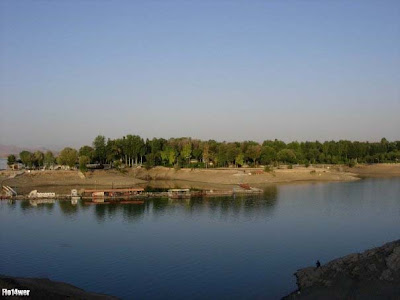
Chadegan Reservoir on the Zayandeh River is the largest in Isfahan Province. It was formed in 1972 by the Zayandeh Dam. The dam was initially named Shah Abbas Dam after Shah Abbas I, the most influential king of the Safavid dynasty, but it was changed to Zayandeh Dam after the Islamic revolution in 1979. Since 1972, the Chadegan Reservoir has helped prevent seasonal flooding of the Zayandeh River.


Wednesday, 2 May 2007

Kashan-Niasar: In The Middle of Vast Deserts!


In the middle of vast deserts and beautiful mountains there is a beautiful small village with lots of flowers, a waterfall and caves hidden in the desert surrounded by mountains.


The green and beautiful resort village of Niasar is located 28 kilometers west of the city of Kashan, Isfahan province. Niasar’s Sassanid monument is a domed building constructed over a rock at the highest point of Niasar village which can be seen from afar.


Niasar cave, with its entrance openings, located in gardens north of Niasar village, is a temple belonging to followers of Mitra (god of ancient Persia). The temple most probably dates back to the early Partian era. All but one of the chambers of the cave are man-made.The Eid-ul-Adha (Al-Adha feast) held in Niasar lends proof to the fact that people living in the region in the olden times believed in Mithraism.


Thursday, 25 January 2007

Dying to get in


A while ago I read about American scholar Richard Frye. He likes Iran so much, his will is to be buried in Esfahan. Watch CNN"s Iranian news presenter interviewing him


Richard Frye interview with IRIB in Persian

http://www.youtube.com/watch?v=zzT-s5brZMk


Richard Nelson Frye (born January 10, 1920) is an American scholar of Iranian and Central Asian Studies, and Aga Khan Professor Emeritus of Iranian Studies at Harvard University. His professional areas of interest are Iranian philology, and the history of Iran and Central Asia before 1000 CE.